
The Arkansas River carved its path through the heart of the Rocky Mountains over millions of years, and today it delivers some of the most legendary whitewater in the country. The roar of Sunshine Falls in the Royal Gorge echoes through both geologic time and human history. What gives this Colorado waterway its character is a story of geology, gold rushes, and the pioneering spirit that turned a rugged frontier into a premier destination for Arkansas River rafting.
From Ancient Headwaters to a Frontier Border
The story of the Arkansas River in Colorado begins with raw power. As the Sawatch Range rose, the river’s headwaters near Leadville began a steep descent, dropping roughly 5,000 feet across its first 125 miles. That gradient is the natural engine behind the rapids that make the Ark one of the most popular whitewater rivers in the United States.
Long before it drew paddlers, the river was a vital resource and a political boundary. From the Adams-Onís Treaty of 1819 until the Mexican-American War ended in 1848, the Arkansas River marked the official international border between the United States and Spanish, then Mexican, territory. Every paddle stroke through its canyons crosses a former frontier.
The Royal Gorge War: Gold, Silver, and Railroads
The Pikes Peak Gold Rush of 1859 changed the river’s destiny. Prospectors followed the river’s course in search of fortune, and towns like Cañon City sprang up to supply the booming mining camps. The bigger drama unfolded when immense mineral wealth was discovered upstream in Leadville.
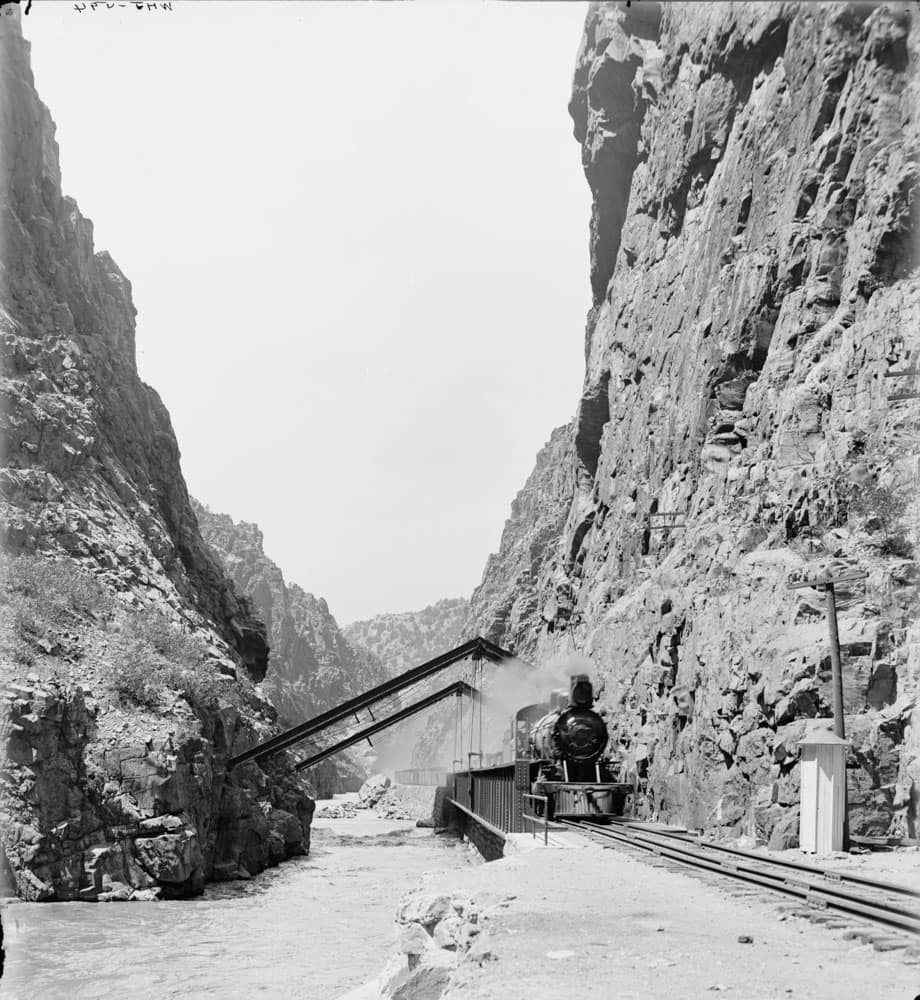
Two rival railroads, the Atchison, Topeka & Santa Fe and the Denver & Rio Grande, fought for the right-of-way through the Royal Gorge. This narrow chasm, roughly 1,200 feet deep, was the only feasible path to move silver and lead ore from the mines. The conflict, known as the Royal Gorge War, involved sabotage, armed standoffs, and years of legal fights before the U.S. Supreme Court sided with the Denver & Rio Grande in April 1879.
The Hanging Bridge, an engineering feat that suspended the tracks over the river where the canyon left no room on the floor, was built as the line pushed through soon after. It remains a landmark of that era’s ambition. Today, rafters on the Royal Gorge trip get an exclusive river-level view of these historic sites, paddling directly past the physical remnants of Colorado’s rugged past.
The Birth of a Whitewater Playground
John Frémont used an early rubber raft for exploration back in 1842, but rafting as a recreational sport took off after World War II, gaining mainstream momentum once whitewater slalom joined the 1972 Olympics. By the 1970s, pioneering outfitters recognized the commercial recreation potential of the Arkansas River, and a new chapter in Arkansas River rafting began.
Echo Canyon: A Pioneer on the Arkansas Since 1978
As one of the first commercial outfitters on the river, Echo Canyon River Expeditions began guiding trips in 1978. With nearly 50 years on the Arkansas River, our roots run as deep as the gorge itself, and we know every rapid by name.
Our legacy is built on a commitment to safety and professionalism that goes well beyond the state standard. Colorado requires at least 50 hours of on-river training for commercial guides. Echo Canyon guides log well over 100 hours, more than double the minimum, across a four to five week program, earning First Aid and CPR certifications, along with a copious amount of Swift Water Rescue training before they take guests out. That depth of preparation is a big part of why Echo Canyon is consistently recognized among the top-rated whitewater rafting companies on the Arkansas River and the best rafting companies in Cañon City, Colorado.
Experience Arkansas River Rafting History Today
When you paddle the rapids of the Royal Gorge (ages 13+ at normal flows) or Bighorn Sheep Canyon (ages 6+), you are moving through country layered with history. From the raft, your guide will point out the remains of old mining sluices, the ruins of a caretaker’s house for a 19th-century water pipeline, and the railroad tracks that sparked a war. These trips are scenic and thrilling, and they double as a journey into the past.
One of the best ways to take in this history is the Raft-n-Rail® package, which pairs a whitewater trip through the gorge with a ride on the historic Royal Gorge Route Railroad. You feel the power of the river from water level, then trace the path of the railroad pioneers from above.
As a complete Colorado adventure basecamp, Echo Canyon offers more than a trip down the river. You can round out your historical adventure with a stay at the Royal Gorge Cabins and a meal at the 8 Mile Bar & Grill, right on our property. The full range of Arkansas River rafting trips runs from the gentle Scenic Float (ages 4+, 35+ lbs) to the Class III-IV+ Royal Gorge, which can reach Class V at the highest June flows. If you are not sure which trip fits your group, our rafting experts can help you choose.
The Arkansas River is more than a collection of rapids; it is a current flowing through the heart of Colorado’s history. Rafting with an outfitter that has been part of that history for nearly five decades adds a depth of experience and storytelling you cannot get anywhere else. You don’t just ride the river, you connect with its legacy.
Ready to paddle through history? Explore Echo Canyon’s Arkansas River rafting trips and choose the adventure that fits your group.