


 The ISRD scale specifically rates the difficulty of whitewater across six grades or classes, most commonly labeled in Roman numerals: Class I, II, III, IV, V, and VI. (You’ll also see them sometimes written in Arabic numerals: i.e., Class 1, Class 2, and so forth.) Note that rapids that fall near the lower or upper limits of a particular class may be differentiated with a minus or plus sign, as in “Class III-” or “Class III+.”
While the ratings most technically apply to individual rapids, the ISRD is often also used to more broadly classify the overall or “average” difficulty of a river or stretch of river, based on multiple factors (rapids, obstacles, remoteness, etc.). You might read about a Class II run, for instance, that contains one Class III rapid.
It’s important to keep in mind that the ISRD means different things for different types of river runners. More challenging classes that are too tricky for a novice whitewater kayaker or other solo boaters to attempt can be doable for beginner rafters tackling the stretch with experienced guides.
So, what do these classes of rapids for whitewater rafting imply? Below, we’ll break down each grade, and also (where applicable) mention particular rapids/routes among the trips we lead here at Echo Canyon that serve as examples.
 Class I: This first class covers what’s essentially mainly a flatwater route with some riffles or little waves. Class I “whitewater” usually runs through a broad channel, and the best course to follow, if there even is a particular one, is obvious and easy. There’s little risk of ending up in the water, and, if you do, self-rescue is straightforward. Many calm stretches between rapids in Bighorn Sheep Canyon or the Royal Gorge qualify as Class I.

Class II: Class II rapids may include mid sized waves, occasional boulders, and mildly troublesome eddy lines, but it’s easy enough to avoid these features with simple maneuvering. Are Class II rapids OK for beginners? Yes! Even novice boaters can often traverse this scale of whitewater without tipping over, but, if that happens, the risk posed to swimmers is usually low, and self-rescue generally remains simple. Here again, our Echo Canyon routes include many Class II stretches with just a few rocks or water features here and there.

 Class III: This intermediate level covers what many rafters and paddlers would consider “real” whitewater, with larger waves and more technical (though still very manageable) maneuvering around boulders, strainers, holes, and other obstacles. Class III rapids have the potential to put a person overboard, but self-rescue normally remains easy, even if group aid is helpful. All things considered, Class III rapids are fun, stimulating, and generally low-hazard. While they may be too much for a beginner kayaker, they can be a great introduction to whitewater rafting. As far as our Arkansas River rafting goes, Fivepoints, Sharkstooth (at most water flows), Double Dip, and Log Jam are examples of Class III rapids within Bighorn Sheep Canyon, while Class III water in the Royal Gorge includes El Primero, El Segundo, Pumphouse, and Lion’s Head.

 Class IV: This is an advanced whitewater grade for steeper drops, bigger waves and holes, and quicker, tighter maneuvering. Scouting is often necessary. Folks tackling Class IV whitewater should be strong swimmers; group rescue is often required when people go overboard. A handful of rapids on our routes—Sunshine Falls, Sledgehammer, The Narrows, Wall Slammer, and Boat Eater—are rated as Class IV at most flow levels.
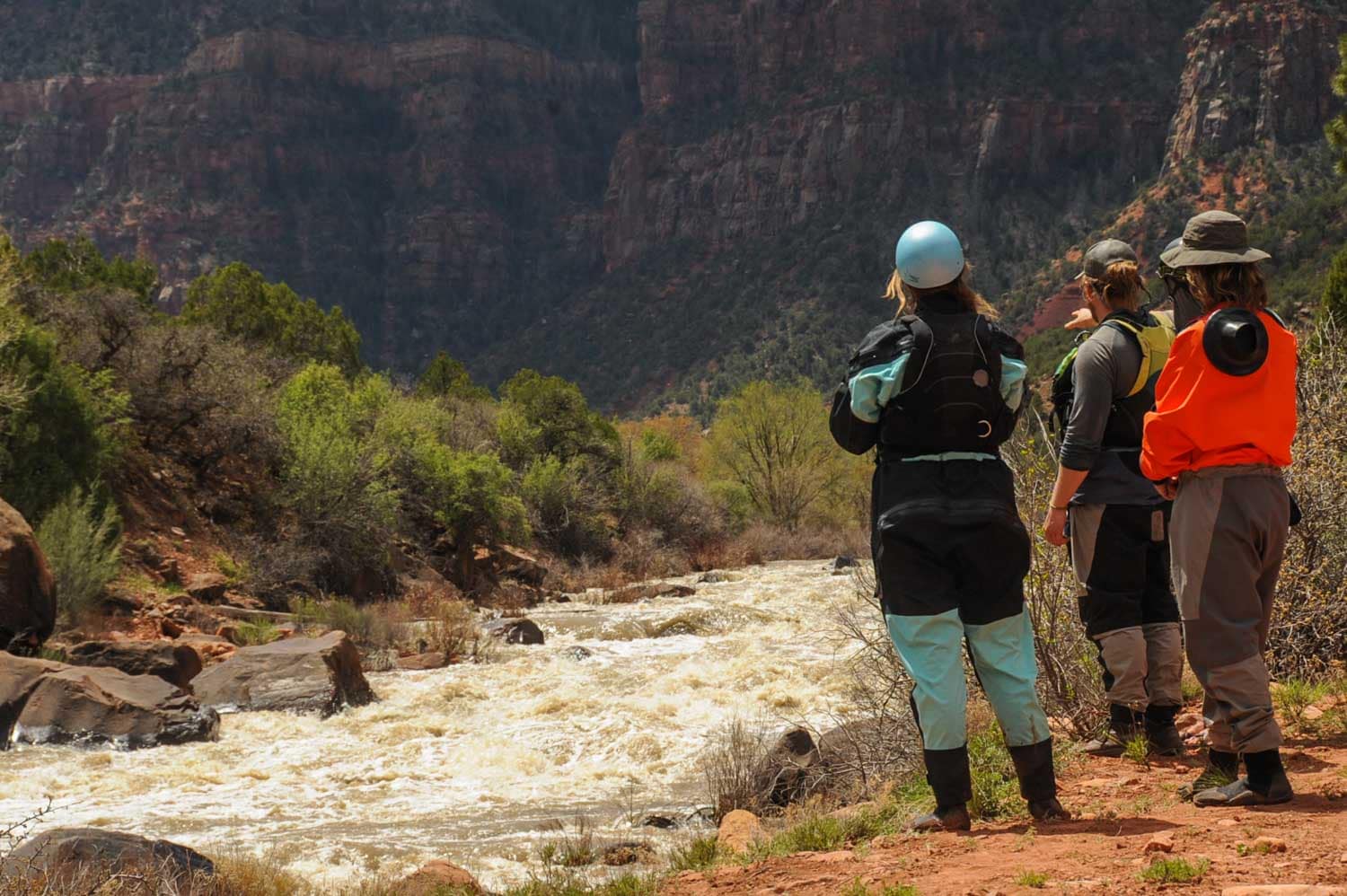
 Class V: We’re upping the ante with Class V rapids, which encompasses expert-level whitewater defined by big, unruly rapids and features such as unavoidable waves and holes, narrow constrictions, complicated lines, and few and/or hard-to-reach “rest stops” (such as eddies). Swimming in Class V whitewater is dangerous, and group rescue tends to be highly technical. A few of our rapids—Sunshine Falls, Sledgehammer, and The Narrows—sometimes crank into Class V territory during high-volume flows (most commonly in June, during peak snowmelt runoff). While we’re on the topic, check out these Class V whitewater rafting tips so you’re as prepared as possible for this level of river experience.

 Class VI: The American Whitewater Association labels Class VI as “extreme and exploratory rapids,” which gives you some idea of the skill level required to even think about trying such whitewater. Only the most expert of river runners should do so, and then only in the most favorable conditions. “The consequences of errors are very severe,” American Whitewater notes, “and rescue may be impossible.” You’ll be glad to know we don’t have any rapids of this magnitude on our river stretches. Needless to say, commercial rafting guests who are river-running novices have no business attempting Class VI rapids.

 They sure can! Water flow and volume play a major role in establishing the difficulty level of rapids and river stretches, and because discharge typically varies, so does the rating.
While higher flows often increase the difficulty rating—larger and burlier waves, faster speed, and thus shorter reaction windows, etc.—they can also lower it: More water may submerge boulders, for example, that at lower flows demand more skillful maneuvering. A good rule of thumb is that very high and very low water tends to bump up the class of rapids.
Rivers are also naturally unpredictable and evolving phenomena, bear in mind. Exceptional high-volume discharges, including floods, can reshape a stretch of river—adding logjams, undercutting banks, rearranging boulders—and thus change its difficulty grade.
The whitewater runs we enjoy here at Echo Canyon certainly vary throughout the season. The best time to raft our stretches of the Ark is usually mid-April through mid-September, with peak flows—some of Colorado’s finest whitewater—normally landing between mid-May and early July.
Now that you have a grasp on how we classify rapids it’s time to select the trip that is just right for you! For that, check out our blog post with tips for selecing rafting trips.
